
Language

1.webp)
Automatic Conveying System
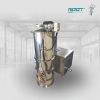
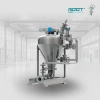
Combining both pneumatic and mechanical methods, we select the most suitable and safe conveying solution for you based on the physical properties of the materials.
.webp)
.webp?x-oss-process=image/resize,w_100/quality,q_100)
.webp?x-oss-process=image/resize,w_100/quality,q_100)
For the conveying of powder and granular materials, pneumatic conveying and mechanical conveying methods can be adopted, and these two methods are often used in combination in the system. Pneumatic conveying can be either positive-pressure conveying or vacuum negative-pressure conveying, while positive-pressure conveying can be further divided into dense-phase conveying and dilute-phase conveying. We fully consider the characteristics of materials such as hygroscopicity, viscosity, particle size, fluidity, bulk density, and electrostatic charge. At the same time, we also take into account that some powder materials have special properties such as flammability, explosiveness, toxicity, and harmfulness, so as to select a suitable and safe conveying method.
1.Precise conveying, efficient and reliable
Due to the complex characteristics of powder materials, the pneumatic conveying system is relatively complex. When providing a pneumatic conveying solution, we need to design a reasonable plan based on process requirements, material characteristics, system scale, and spatial location. In a single powder conveying solution, multiple conveying methods are often comprehensively applied. High automation, energy efficiency, and environmental friendliness are the most prominent features of the powder conveying system.

|
chemical engineering |
pharmaceuticals |
electronics |
automotive |

It is suitable for industries such as chemical engineering, pharmaceuticals, electronics, automotive, food, warehousing and logistics, and e-commerce.
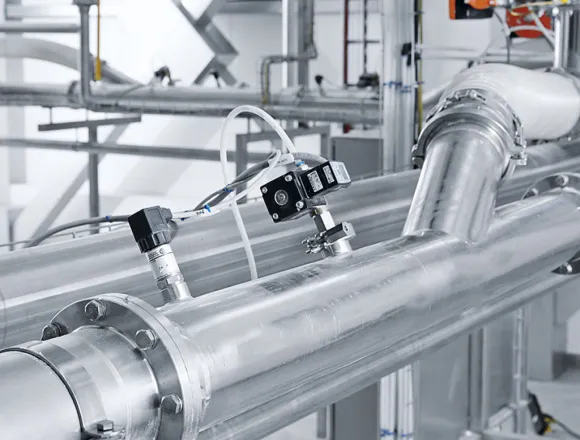
1.Positive-pressure pneumatic conveying uses airflow to transport materials in closed pipelines and is divided into two methods: dense-phase conveying and dilute-phase conveying.
2.Dense-phase conveying: It has a high solid content (10-30 kg/m³), low gas velocity, and high air pressure. Driven by compressed air, its core equipment is a bin pump. It is suitable for scenarios requiring long conveying distances and low wear requirements.
3.Dilute-phase conveying: It has a low solid content (1-10 kg/m³), high gas velocity (18–30 m/s), and low system pressure. It can be in positive-pressure or negative-pressure form, with a simple configuration. It is suitable for lightweight and medium-short distance conveying.
4.Both methods can realize operations such as heating, cooling, and drying during conveying. The system has a compact structure and can be arranged horizontally, vertically, or obliquely.
Negative-pressure pneumatic conveying (also known as vacuum feeding) uses the vacuum negative pressure generated in the system (usually provided by a vacuum pump or roots blower) to suck powder and granular materials into the target equipment.
This method features simple equipment, easy operation, low cost, and flexible installation. However, it has a relatively short conveying distance and limited conveying capacity, making it more suitable for production scenarios where the powder consumption is small and the conveying requirements are not high.
Mechanical conveying includes screw conveying, pipe chain conveying, and bucket elevator conveying. During system design, we select an appropriate feeding method based on the characteristics of process materials and in combination with the spatial location of the workshop.
Related Products

CONTACT US
Contact US
Product Information
Quantity
Unit
Piece
Support order samples, customization, wholesale direct, and complete payment. If the product you look for does not have corresponding customized content, pls fill out the form below to contact us, and we will reply ASAP.